|
The journey for SPHS students traveling to Greece began on March 28th at 300 A.M. Twenty-eight hours later, Marieke, our tour director who speaks six languages, greeted us in Athens, and we were immediately propelled into the past as we entered the sprawling Acropolis. Suddenly, we found ourselves at the awe-inspiring Partheneon, a temple that was dedicated to Athen’s patron saint Athena. |
SPHS Students Travel Through History in Greece
May 15, 2013
Santa Paula High School
By Samuel Ramirez
SPHS Foreign Language Teacher, Santa Paula High School
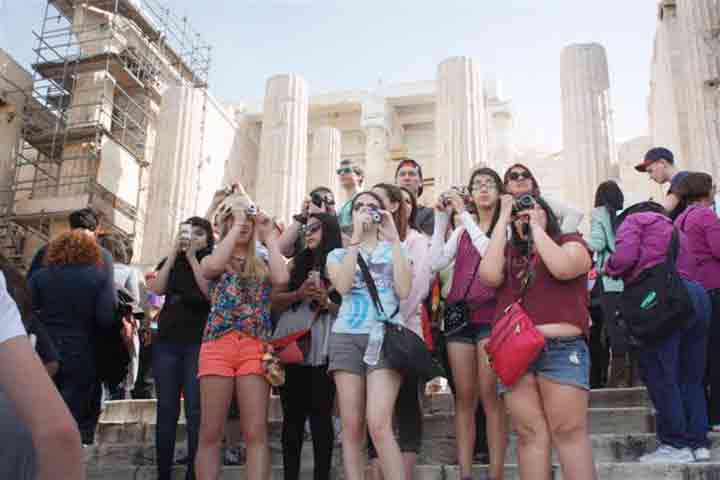
The journey for SPHS students traveling to Greece began on March 28th at 300 A.M. Twenty-eight hours later, Marieke, our tour director who speaks six languages, greeted us in Athens, and we were immediately propelled into the past as we entered the sprawling Acropolis. Suddenly, we found ourselves at the awe-inspiring Partheneon, a temple that was dedicated to Athen’s patron saint Athena. Our eyes marveled at the sculpted women holding up the roof with their heads and the amazing view of modern Athens below. It was a dream come true for all of us; we became a part of history walking in on wrought-iron balconies, participating in traditional dances in basement taverns, and getting lost in the Temple of Olympian Zeus. This construction began in the 6th century B.C. and was finished in 132 A. D. by the emperor Hadrian. When we jumped back to the present, we found ourselves in the Syntagma Square, the center of the modern city, where we observed the Parliament building and the British-style changing of the guard’s ceremony.
The following day we were transported again to the past to contemplate the impressive ruins at Delphi, which the Greeks considered the center of the world. It was in the depths of the Temple of Apollo where a priestess would inhale intoxicating vapors that used to rise from the earth and, thus inspired, delivered the prophecies of Apollo.
Our time travel through history continued as we explored six Greek islands on a cruise. Our first stop was in the colorful town of Kusadasi on our way to Ephesus, which is famous in antiquity for its Temple of Diana. During the years of the Roman Empire it was the greatest city in Asia Minor. We discovered innumerable monuments that included the Forum, the Odeon, the library of Celsus, the Great Theatre built in the Greek Era and reconstructed in the Roman period, the humble chapel on the little house in which it is believed that the Virgin Mary spent her last days, and many other wonders. We took numerous pictures of the ancient city of Ephesus and saw one of the most magnificent excavations in the world, the Basilica of St. John and The Great Theatre with a capacity of 24,000 seats where St. Paul preached. In the present, we could only try to read the inscriptions in the ancient Greek language that are still present. As we returned to our ship, we got a taste of Turkey by enjoying an exhibition of oriental carpets, jewelry, and leather goods.
In Patmos, we visited St John’s monastery, built within the walls of a strong fortification. Patmos’ country side is admired for its labyrinth-like architecture of the village. The windmills, the Grotto of the Apocalypse, and the dry rocky landscape contrasting with the blue of the sea, immersed us in the Greek’s history. We were astonished by the outstanding natural beauty of rocky hills, dozens of tongues of land reaching out into the sea, tranquil beaches and many picturesque inlets.
In Rhodes, we arrived at the Citadel of the Knights. Its medieval walls were constructed by the knights of St. John in the 13th Century. They surround the ancient Acropolis of Lindos, on the brink of a precipice 122 m above the sea. We could not believe our eyes as we viewed the tumble of massive pillars of the Temple of Athena, the stadium of Diagoras and the port, once protected by the Colossus of Rhodes. We strolled with pleasure on the streets of the Knights admiring its medieval buildings, winding alleys, towers and turrets.
In Crete, the largest and most rugged of the Greek islands, and the home of the Minoan Civilization and Zeus, some students contemplated the Minoan Palace of Knossos which is decorated with frescoes and shields. They stepped into one of the oldest farmhouses which date back to the Minoan period; they tried different assortments of Cretan snacks and locally produced wine (adults) and tea while listening to local Greek music. Others visited the Venetian Heraklion and the unique archaeological museum. Founded in 824, Heraklion is the homeland of many contributors to literature and art, such as the Nobel winning poet Odysseas Elytis, the Renaissance painter Domenikos (El Greco) and the writer Nikos Kazantzakis.
Our last stop was in Santorini, where we visited the spectacular Oia Village that is perched on the Caldera Rim. It was a breath-taking view; all of us inhaled clean and pure air as we headed up to the monastery of Prophet Illias, Fira Village, Firostefani and Imerovigli, which are all decorated with delicate architecture. From atop we admired the panoramic view of the Aegean Seas and the neighboring islands. The Oia Village is built on the Caldera rim; it is an excellent example of Cycladic architecture. Its cobble-stone streets and the white washed houses with blue shutters give everyone the impression that they are in a beautiful post card. At the end, we strolled through the marble-paved alleys, gazed at the adorably cute shops, and became acquainted with the characteristic buildings carved into the rocks. We all enjoyed this surreal landscape, but it was time to return to the present.
As a teacher, I am blessed to have been part of such history and to have had the privilege to travel with these students. I was impressed by their hunger for learning, their bonding, and their interaction in a world that is very different from theirs. We were sad when we left Greece and gave farewells to other students and our tour guide. We returned with new adventures, new friends, and a desire to explore the world first-hand in the coming years. I want to thank our parents for allowing their child to be part of such great network of the educated, Dr. Yamamoto, and our community for supporting our children.