Museum hours: “Let’s Go to the Moon! The Lunar Missions” exhibit runs through June 24 at The California Oil Museum. It is open Wednesday through Sunday, 10 a.m. to 4 p.m. Admission is $4 for adults, $3 for seniors, $1 for youths and free for museum members. For more information, call 933-0076 or log on to www.oilmuseum.net.
A journey of 238,900 miles to the moon is now just a click away. Santa Paula students can ditch their spacesuits and explore the universe with their cell phones, tablets and computers.
Students are even taking control of tracking devices in outer space from their classrooms.
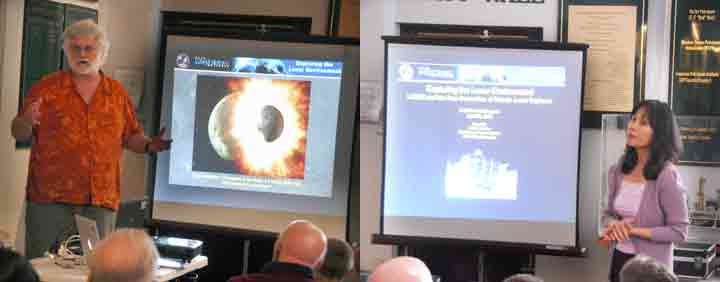
“That’s neat,” said Brian Day from the NASA Lunar Science Institute at the Ames Research Center in Northern California. He and Emily Law, a science data systems manager from the California Institute of Technology’s Jet Propulsion Laboratory in Pasadena, wowed a crowd at Santa Paula’s California Oil Museum on Sunday, showing off the latest “apps” for exploring outer space. They brought moon rocks, meteors and a model of NASA’s Lunar Atmosphere and Dust Environment Explorer (LADEE). Their talk is part of the museum’s Lunar Missions exhibition that runs through June 24.
Timing is everything for the LADEE mission, which will launch in the fall to explore the moon’s thin atmosphere. With the United States and other countries looking to explore the moon, the moon’s atmosphere will change, so it is important to gather data now, Day said.
Telescopes with 8- to 14-inch apertures are ideal for “catching meteoroid impacts on the moon,” Day said. But a telescope is not necessary to see the tons of meteors that fall to Earth every day. Anyone can grab a lawn chair, simply look up and send their observations to NASA with the free Meteor Counter app on an iPhone or Android phone. It allows observers to tap their phone screen to note the brightness of a meteor and records the time of the meteor sighting and the meteor’s magnitude. It includes an optional voice recorder for those who want to describe what they’re seeing. That information can then be uploaded for NASA researchers to analyze.
Ham radio operators can also “listen” for meteors that fall during the day, making it a popular hobby for the visually impaired, Day said.
“This information belongs to you,” Day said, explaining that taxpayers fund NASA, which has created “tools so you can manipulate all this data that has come back from the moon.”
The latest online space-exploration tool is an app called Moon Tour, which will be available in a month or two. With it, explorers can feel like they are clambering over craters with the help of 3D images. “Imagine the science-fair projects students are going to be able to do with this,” Day said. Law is working on Moon Tour and has led the development of the Lunar Mapping and Modeling Project, which gives people the ability to browse the lunar data collected in all the missions.
Since the talk was given at the oil museum, it was only natural that someone would ask who owns the mineral rights on the moon. “Nobody owns the moon,” similar to no one owning Antarctica, Day said, but explained there is a whole area of space law that is still being worked out.
Moon rocks are of great interest to scientists because, just like earth rocks, they tell stories, Day said. The earliest rocks on Earth have long ago eroded. However, the moon, which was formed with the Earth, has no wind or rain to erode its rocks, so moon rocks are billions of years old. It’s part of what makes the moon such a “great place to do science, to see how all this began,” Day said.
As the director of communications and outreach, whose fascination with space is contagious, Day speaks at many schools, encouraging students to help NASA scientists explore outer space. NASA’s Web site, www.nasa.gov and its Lunar Mapping and Modeling Portal, www.lmmp.nasa.gov, provide the tools to transport Earthlings to the moon and beyond.