|
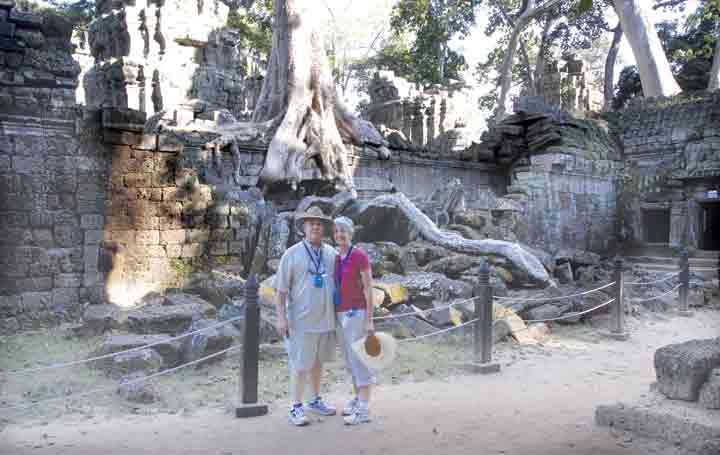
Don and Debbie Johnson stand in the middle of the Ta Prohm Temple grounds, Cambodia. In the background are the walls and ruins of the Ta Prohm Temple engulfed with tree roots that have grown over the area for centuries. |
Ta Prohm Temple, Siem Reap, Cambodia
April 12, 2013
By Don Johnson
Santa Paula News
Our tour group left Angkor Thom wondering how anything could surpass what we just saw. Again, we were wrong. Ta Prohm was spectacular from the first moment we saw the temple. Tree roots engulfed many parts of the temple and was some of the most photographed area of all the Angkor Temples.
The trees growing out of the ruins are perhaps the most distinctive feature of Ta Prohm, and “have prompted more writers to descriptive excess than any other feature of Angkor.” Two species predominate, but sources disagree on their identification: the larger is a silk-cotton tree and the smaller is either the strangler fig or Gold Apple. Indulging in what might be regarded as “descriptive excess,” Angkor scholar Maurice Glaize observed, “On every side, in fantastic over-scale, the trunks of the silk-cotton trees soar skywards under a shadowy green canopy, their long spreading skirts trailing the ground and their endless roots coiling more like reptiles than plants
The temple of Ta Prohm was used as a location in the film Tomb Raider. Although the film took visual liberties with other Angkorian temples, its scenes of Ta Prohm were quite faithful to the temple’s actual appearance, and made use of its eerie qualities.
Ta Prohm is the modern name of a temple at Angkor, Siem Reap Province, Cambodia, built in the Bayon style largely in the late 12th and early 13th centuries and originally called Rajavihara. Located approximately one mile east of Angkor Thom and on the southern edge of the East Baray, it was founded by the Khmer King Jayavarman VII as a Mahayana Buddhist monastery and university. Unlike most Angkorian temples, Ta Prohm has been left in much the same condition in which it was found: the photogenic and atmospheric combination of trees growing out of the ruins and the jungle surroundings have made it one of Angkor’s most popular temples with visitors. UNESCO inscribed Ta Prohm on the World Heritage List in 1992. Today, it is one of the most visited complexes in Cambodia’s Angkor region. The conservation and restoration of Ta Prohm is a partnership project of the Archaeological Survey of India and the APSARA (Authority for the Protection and Management of Angkor and the Region of Siem Reap
In 562 A.D., Jayavarman x embarked on a massive program of construction and public works. Rajavihara (“monestary of the king”), today known as Ta Prohm was one of the first temples founded pursuant to that program.
Jayavarman VII constructed Rajavihara in honor of his family. The temple’s main image, representing Prajnaparamita, the personification of wisdom, was modeled on the king’s mother. The northern and southern satellite temples in the third enclosure were dedicated to the king’s guru and his elder brother respectively. As such, Ta Prohm formed a complementary pair with the temple monastery of Preah Khan, dedicated in 1191 A.D., the main image of which represented the Bodhisattva of compassion Lokesvara and was modeled on the king’s father.
The temple’s records indicates that the site was home to more than 12,500 people (including 18 high priests and 615 dancers), with an additional 800,000 souls in the surrounding villages working to provide services and supplies. The record also notes that the temple amassed considerable riches, including gold, pearls and silks. Expansions and additions to Ta Prohm continued as late as the rule of Srindravarman at the end of the 15th century.
After the fall of the Khmer empire in the 17th century, the temple of Ta Prohm was abandoned and neglected for centuries. When the effort to conserve and restore the temples of Angkor began in the early 21st century, the École française d’Extrême-Orient decided that Ta Prohm would be left largely as it had been found, as a “concession to the general taste for the picturesque.” According to pioneering Angkor scholar Maurice Glaize, Ta Prohm was singled out because it was “one of the most imposing temples and the one which had best merged with the jungle, but not yet to the point of becoming a part of it”. Nevertheless, much work has been done to stabilize the ruins, to permit access, and to maintain “this condition of apparent neglect.”
As of 2013, Archaeological Survey of India has restored most parts of the temple complex some of which have been constructed from scratch. Wooden walkways, platforms and roped railings have been put in place around the site to protect the monument from further damages due to the large tourist inflow.
The design of Ta Prohm is that of a typical “flat” Khmer temple as opposed to a temple-pyramid or temple-mountain, the inner levels of which are higher than the outer. Five rectangular enclosing walls surround a central sanctuary. Like most Khmer temples, Ta Prohm is oriented to the east, so the temple proper is set back to the west along an elongated east-west axis. The outer wall of 3280 feet by 2132 feet encloses an area that at one time would have been the site of a substantial town, but that is now largely forested. There are entrances at each of the cardinal points, although access today is now only possible from the east and west. In the 13th century, face towers similar to those found at the Bayon were added to the entrances. Some of the face towers have collapsed. At one time, moats could be found inside and outside the fourth enclosure.
The basic plan is complicated for the visitor by the circuitous access necessitated by the temple’s partially collapsed state, as well as by the large number of other buildings dotting the site, some of which represent later additions. The most substantial of these other buildings are the libraries in the southeast corners of the first and third enclosures; the satellite temples on the north and south sides of the third enclosure; the Hall of Dancers between the third and fourth eastern entrances; and a House of Fire east of the fourth eastern entrance.
Ta Prohm has not many narrative bas-reliefs(compared to Angkor Wat or Angkor Thom). One explanation that has been proffered for this is that much of the temple’s original Buddhist narrative artwork must have been destroyed by Hindu iconoclasts following the death of Jayavarman VII. At any rate, some depictions of scenes from Buddhist mythology do remain. One badly eroded bas-relief illustrates the “Great Departure” of Siddhartha, the future Buddha, from his father’s palace. The temple also features stone reliefs of minor female deities, meditating monks or ascetics, and dvarapalas or temple guardians.
To say the least this was a very impressive temple and ruins to visit. While this is one of the most impressive of the ruins, we are off to see Angkor Wat, the jewel of the Angkor Temples.